Where do I start? Organizing your parents’ documents
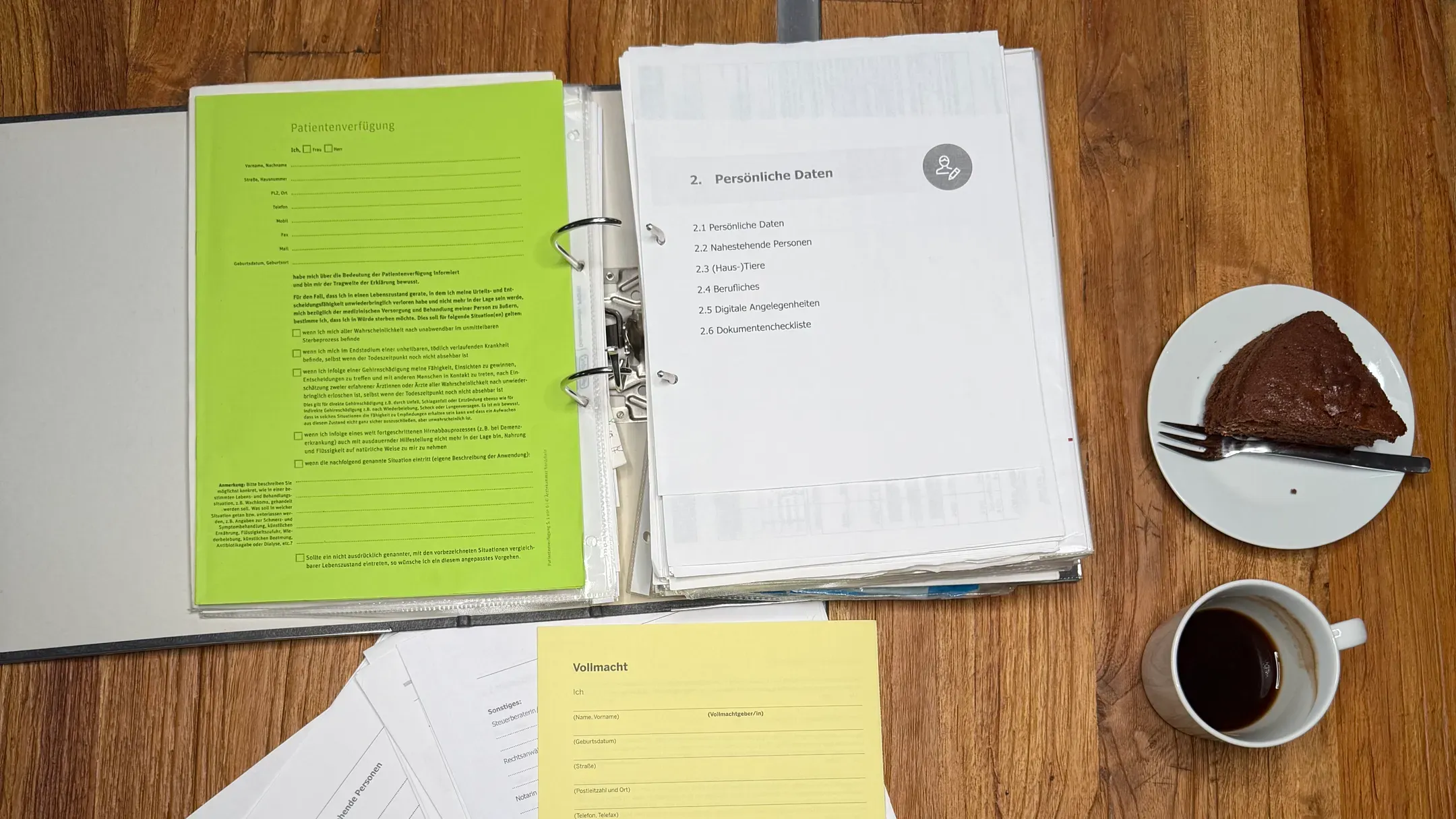
Your mother sends you a message: “Will you help me with my paperwork? I’ll bake your favourite cake.” On Sunday there are three binders on the kitchen table, the cake next to them. She wants to get things in order. And she wants to be sure that someone knows where everything is.
You said yes. Now you are sitting in front of the binders thinking: where do I start?
The good thing about this moment: she started it, not you. For her it is not about the end. It is about taking a load off you. That makes the afternoon easier than it feels.
Why starting is so hard
Your parents’ papers are rarely in one place. Some are in the binders in the cupboard. Some are in the drawer with the letters that were going to be sorted one day. There is a box in the cellar nobody can remember the contents of. And last month’s letter from the bank is still unopened on the sideboard.
Only your mother knows what is where. And some of it she no longer knows herself. She took out the contents insurance twenty years ago. The policy is filed somewhere, probably.
Then there is the conversation itself. It feels as if it were about illness and goodbyes. In fact it is about an afternoon at the kitchen table sorting paper.
And there is the standard you set yourself. If you are going to do it, do it properly: go through everything and miss nothing. That standard is exactly why the binders have stayed in the cupboard for years. A whole free weekend never comes.
It is not about a finished folder
You do not need to set up a complete preparedness folder today. That is the wrong goal for a first afternoon. It is too big, and it is not what your mother means when she talks about order.
Order here means: someone other than her knows where everything is. You know which binder holds the insurance policies, and you know that the power of attorney is with the notary and a copy is in the left-hand drawer. That is all it takes to begin.
It is a smaller goal than “everything sorted”. It is the right one. For your mother it is relief: she no longer carries the overview alone. For you it is help you can give today rather than some day. Each of you is doing it for the other. That is why it works at all.
Organizing your parents’ documents: start with these four areas
Start with the papers you would need if you ever had to make a phone call on your mother’s behalf. The insurer asks for the policy number, and the bank wants to know who is calling in the first place.
Four areas are enough to begin with:
- Insurance: health insurance, liability, home contents. The policy or the latest letter with the policy number.
- Powers of attorney and directives: power of attorney, living will. If they exist, where the originals are. If they do not, that is a conversation of its own.
- Ongoing contracts: rent, electricity, phone, the bank account. One letter each with the customer number.
- Pension: the most recent pension statement.
What a power of attorney has to contain, and whether the living will still fits, is something your mother settles with a notary or a lawyer. That is not today’s job. Today is only about the document being findable.
Everything else can wait. The old bank statements and the warranty card for the television stay in the binder. They are not going anywhere.
How the conversation starts
Often it starts the way it did with your mother. She offers something because the matter is important to her. The cake and a Sunday afternoon. Take the offer, even if the timing is bad. It does not come round often.
If the first move has to come from you, a small question works better than a big talk. “We need to talk about everything some time” sounds like the end. “Where is your liability insurance, actually?” sounds like a Tuesday. The second question can be answered. It leads to a binder, the binder leads to a drawer, and suddenly you are in the middle of it.
What matters is that you stay on an equal footing. Your mother has kept these binders for decades. She knows more about them than you do. You are not bringing the order. You are the second person who knows.
If you have a sister or a brother, tell them today. You share the responsibility, so share the overview too. It is enough if one of you knows the binders. It is better if both of you do.
A photo is enough
You do not need a scanner or a free Saturday. You need the phone that is lying on the table anyway.
Take the document in your hand and photograph it. Then the next one. Not the whole binders, just the papers from the four areas. By the end of the afternoon you have a handful of photos and know for each one where the original is. That is all the first afternoon is. It does not need to be more.
It will not be quick. And it will not be complete straight away. There is always one more contract nobody remembered. It turns up when it turns up, and then you add it.
What is true after the first afternoon: more is in order than before. And someone knows where it is.
What counts in the end
Your mother knows that someone knows. That was her wish, and it is granted before the cake is gone. You know where to look if you ever have to look. And you have started something that can now carry on in small pieces. One binder on the next visit. The drawer on the one after.
And if you are thinking that it is about time at your parents’ place too: call them. Ask about the liability insurance. You will probably have to bring the cake yourself.
If you are looking for a place to keep all of this: Teulu asks you in every module “Do you have …?” and shows you what is still missing, across more than 100 document types in 11 modules. With the Teulu app for iPhone and iPad, you capture the documents with the camera and upload them right there in the app, with no scanner and no detour via your computer. So you do not need to know beforehand what belongs. But with or without Teulu: starting is small. It is enough that someone knows where everything is.